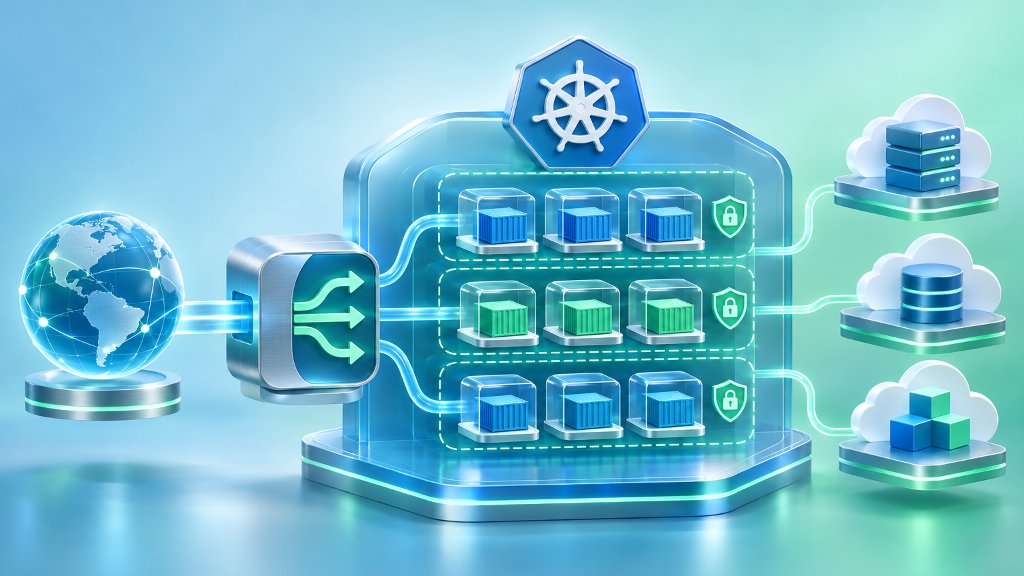
Kubernetes administrators should make Gateway API the standard interface for exposing services and managing traffic at the cluster edge. It offers clearer ownership boundaries, stronger cross-namespace controls, and more portable routing than annotation-heavy Ingress configurations.
Gateway API replaces frozen Ingress
Ingress is not going away, but Kubernetes has stopped developing its API. The Kubernetes documentation says the Ingress API is frozen and recommends Gateway for new deployments. Gateway API is its successor, although it uses different resources and requires a one-time conversion from existing Ingress objects. (Kubernetes Ingress documentation; Kubernetes Gateway API documentation)
Gateway API is delivered as a set of custom resources. Its core model separates infrastructure from traffic rules. A GatewayClass identifies the controller, a Gateway represents a traffic-handling endpoint such as a cloud load balancer, and an HTTPRoute or GRPCRoute connects requests to Kubernetes Services. The model supports separate infrastructure, cluster-operator, and application roles. (Kubernetes Gateway API documentation)
Separate platform and application ownership
This separation creates a clearer operating model. Platform administrators can control which GatewayClass objects exist, which load balancer types are permitted, and which namespaces may attach routes. Application teams can manage route rules without receiving permission to create or modify the underlying public Gateway.
In practice, platform administrators can own GatewayClass and shared Gateway resources, while application teams create routes in their own namespaces. The Gateway listener then determines which namespaces and route kinds may attach. By default, a Gateway accepts routes from its own namespace, so broader access should be an explicit policy decision rather than an accidental result of shared infrastructure. (Gateway API security guidance; Kubernetes Gateway API documentation)
This division also makes reviews easier. Teams can evaluate a route change as an application deployment change, while a change to a public listener, TLS certificate reference, or load balancer remains a platform change. That separation reduces the chance that a routine application release will alter cluster-wide network exposure.
Control cross-namespace trust
Cross-namespace routing extends this model, but it creates a trust relationship that administrators must control. Gateway API uses allowedRoutes on listeners to determine which namespaces may attach routes. For references to resources in another namespace, such as a Service or Secret, the resource owner must create a ReferenceGrant. Without that grant, the cross-namespace reference is invalid. (Gateway API ReferenceGrant documentation)
Administrators should keep each grant narrow. They should specify the source namespace, source kind, destination kind, and resource name whenever the API supports it. Broad grants can allow every route in a namespace to reference every backend. The Gateway API security guidance also recommends admission controls that limit who may create grants and which trust relationships they may express. (Gateway API security guidance)
Creating a Gateway should also be a privileged operation. A new Gateway may create cloud infrastructure, public addresses, DNS records, or other billable resources. Kubernetes administrators should reflect that risk in RBAC roles and admission policies instead of giving ordinary application accounts unrestricted Gateway permissions. (Gateway API security guidance)
Adopt stable features first
Gateway API has separate Standard and Experimental release channels. Administrators should prefer Standard resources for production systems. They should treat Experimental resources as evaluation work unless the selected implementation documents a clear support commitment.
Gateway API v1.6.0 was released on June 30, 2026, and promoted TCPRoute and UDPRoute to the Standard channel. This extends the stable routing model beyond HTTP and TLS to raw TCP and UDP traffic. The release also moved new Experimental resources into a separate API group, making the boundary between production-ready and experimental features clearer. (Kubernetes Gateway API v1.6 release announcement)
Before selecting a controller, administrators should compare its conformance results and supported features. Gateway API specifications are portable, but each controller still determines which optional capabilities are available. The implementation guide says controllers should publish supported features in GatewayClass status. That gives administrators a machine-readable way to compare capabilities. (Gateway API implementer guide)
Plan migration as a network change
Administrators should not treat an Ingress conversion as a simple file rename. Ingress controllers often place important behavior in annotations, ConfigMaps, or controller-specific extensions. Gateway API provides standard routing features, but each migration still needs an inventory of hostnames, paths, TLS handling, redirects, authentication, timeouts, and traffic-splitting rules. (Ingress2Gateway 1.0 announcement)
Teams should start with one low-risk service and compare the old and new paths under normal traffic. They should keep the migration reversible until DNS, certificates, health checks, access policies, and observability have been validated. The Kubernetes project’s migration documentation and the Ingress2Gateway project provide resources for mapping existing Ingress configurations to Gateway API resources. (Kubernetes Gateway API documentation; Ingress2Gateway 1.0 announcement)
The long-term management goal is a small set of approved GatewayClasses, clearly owned shared Gateways, narrowly scoped route permissions, and dashboards that show Gateway and Route status conditions. This gives administrators a consistent control plane for ingress without requiring every application team to understand the underlying load balancer or proxy implementation.
References
Kubernetes. (n.d.). Gateway API. Kubernetes Documentation. https://kubernetes.io/docs/concepts/services-networking/gateway/
Kubernetes. (n.d.). Ingress. Kubernetes Documentation. https://kubernetes.io/docs/concepts/services-networking/ingress/
Modebadze, B., & Katz, R. (2026, August 3). Gateway API v1.6: TCPRoute and UDPRoute graduate to Standard. Kubernetes Blog. https://kubernetes.io/blog/2026/08/03/gateway-api-v1-6-release/
Gateway API. (n.d.). Security. https://gateway-api.sigs.k8s.io/docs/concepts/security/
Gateway API. (n.d.). ReferenceGrant. https://gateway-api.sigs.k8s.io/reference/api-types/referencegrant/
Gateway API. (n.d.). Implementer’s guide. https://gateway-api.sigs.k8s.io/guides/implementers-guide/
Modebadze, B., & Jin, S. (2026, March 20). Announcing Ingress2Gateway 1.0: Your path to Gateway API. Kubernetes Blog. https://kubernetes.io/blog/2026/03/20/ingress2gateway-1-0-release/