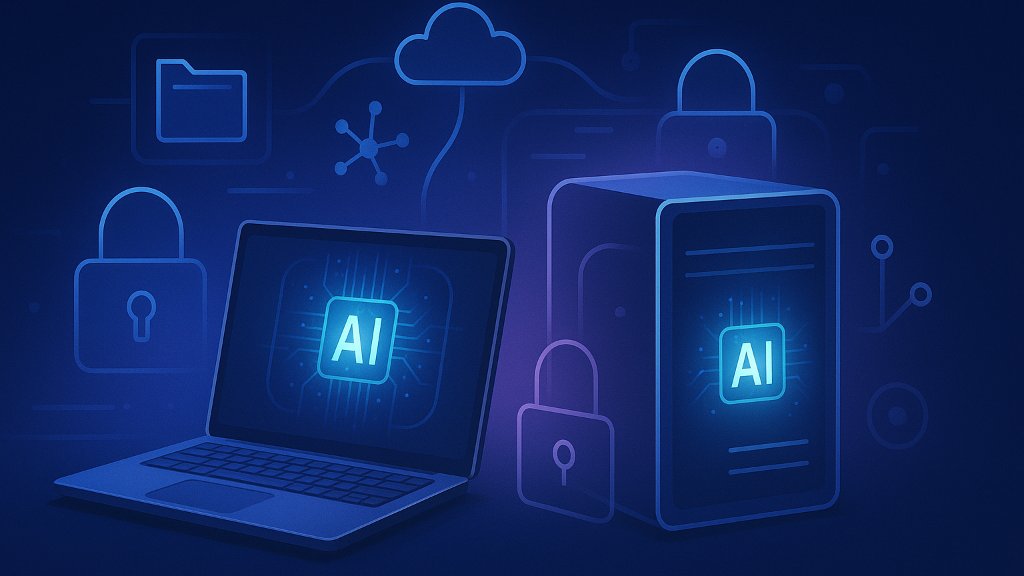
Microsoft Rebuilds Windows Around Local AI and Contained Agents
Microsoft is repositioning Windows as a platform for hybrid intelligence, where AI work can move between the cloud and a user’s PC. The company also made Microsoft Execution Containers generally available, giving developers and organizations a way to limit what autonomous agents can access and do.
The announcements were published October 7, 2026, and address two challenges created by increasingly capable AI agents: the need for more local computing power and the need to control software that can read files, run tools, write code and take actions.
Windows gets a security boundary for agents
Microsoft Execution Containers, or MXC, lets developers and IT administrators define policies for an agent workload. Policies can specify which files an agent may read or modify, which network destinations it can reach, whether it can interact with the desktop and how its process should run.
The boundary is enforced by the platform rather than by the AI model. If an agent-generated script attempts an operation outside its policy, the container is designed to block it even if the agent believes the action is necessary.
MXC supports process containers across Windows 11, macOS and Linux. Windows also supports session containers and WSL containers, while MicroVM support is listed as experimental for Windows 11 and Linux. Microsoft says Windows 365 support for MXC is generally available.
Microsoft says leading agents and frameworks already supporting MXC include GitHub Copilot, OpenClaw, OpenAI Codex, Replit, LM Studio, NVIDIA OpenShell and Unsloth AI. Planned support includes Anthropic Claude Code, Box, Egnyte, Heidi Health, Hermes Agent, Manus, Perplexity, Raycast and Simular.
Local models become a bigger part of Windows
Microsoft’s broader strategy is to route each task to the most appropriate place. Local models can handle suitable or sensitive work, while cloud models can handle tasks that require more capability. Microsoft says this approach can help customers manage cloud-token use and keep some AI processing on the device.
Microsoft is bringing MAI Code 1.1 Flash to local PCs using 3-bit precision. The model has 137 billion total parameters and 6.8 billion active parameters, and Microsoft says the local version is nearly 80 percent smaller while supporting a 256K context window. Windows ML is also gaining support for the open-source llama.cpp runtime.
On Copilot+ PCs, Microsoft plans to add permission-based local context, local actions and local-model support. The company says these features will begin rolling out in the coming months, with availability varying by device, market and silicon platform.
New hardware targets local AI workloads
Microsoft announced the Surface Laptop Ultra and Surface RTX Spark Dev Box, along with RTX Spark systems from ASUS, Dell, HP, Lenovo and MSI. The Surface Laptop Ultra supports up to 128 GB of unified memory and is designed to run AI models exceeding 120 billion parameters locally.
The Surface Laptop Ultra is available for preorder and is scheduled to begin shipping October 16, 2026. The Surface RTX Spark Dev Box is scheduled to ship to customers in the United States in November.
How developers can get started
- Review the MXC repository and identify the files, tools and network destinations an agent actually needs.
- Integrate the MXC SDK and define a least-privilege policy using the documented configuration schema.
- Use Learning or Permissive mode to observe attempted access and refine the policy.
- Switch to Enforcement mode after testing, so operations outside the approved boundary are blocked.
Microsoft’s announcement reflects a broader shift in AI software: giving agents more autonomy while treating their permissions as an operating-system security problem.
References
Davuluri, P. (2026, October 7). Building Windows for hybrid intelligence. Windows Experience Blog. https://blogs.windows.com/windowsexperience/2026/10/07/building-windows-for-hybrid-intelligence/
Iyer, L. (2026, October 7). Microsoft Execution Containers: Policy-driven containment for AI agents. Windows Developer Blog. https://blogs.windows.com/windowsdeveloper/2026/10/07/microsoft-execution-containers-policy-driven-containment-for-ai-agents/
Microsoft. (2026). Microsoft Execution Containers repository. GitHub. https://github.com/microsoft/mxc/tree/main