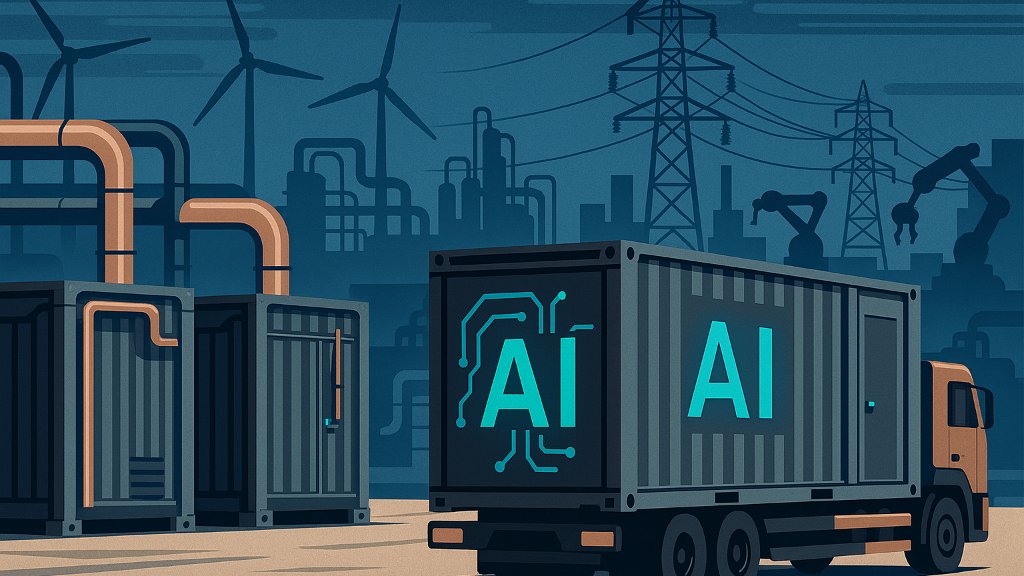
Nvidia unveiled a modular data-center design on October 21 aimed at helping Europe build AI capacity faster. The announcement matters because European developers currently have about 5% of the world’s AI computing capacity, compared with about 75% in the United States, according to The Associated Press.
DSX POD cuts deployment time
CEO Jensen Huang presented DSX POD at Nvidia’s GTC conference in Berlin. The container-based design is intended for Vera Rubin AI factories. Nvidia says partners can assemble and test the computing, networking, cabling, power systems and liquid cooling before delivery.
Nvidia says a prepared site could receive a working unit in as little as 14 days, compared with roughly six months for a conventional deployment. The company plans to work with partners including Dell Technologies, HPE, Lenovo, Schneider Electric and Vertiv. Worldwide deployments are expected to begin in early 2027. (Nvidia)
DSX targets power and water
Nvidia also described DSX as a broader platform for designing and operating AI data centers. Its MaxLPS software is intended to produce the same number of AI tokens with up to 30% less power. DSX Flex can adjust workloads in response to grid conditions.
The company says closed-loop liquid cooling and dry coolers can bring facility cooling-water use close to zero. At a 2-gigawatt deployment, Nvidia estimates potential savings of 54 million liters of water per day. Nvidia also notes that local climate can determine whether additional mechanical cooling is needed. (Nvidia)
European industry joins
Huang said Europe’s opportunity is to apply AI to manufacturing and other physical industries. Nvidia said it invested $10 billion in European startups and partners during the past year. Companies including Siemens, Mercedes-Benz and Volkswagen’s Audi were highlighted at the Berlin event.
Nvidia also announced partnerships around autonomous vehicles. Bolt with Lucid, Mercedes-Benz, Volkswagen Commercial Vehicles and Einride are showcasing mobility projects based on Nvidia’s Hyperion platform. Volvo Cars is adopting Nvidia software for automated driving. Bolt plans to begin collecting real-world driving data in Madrid in 2027, subject to regulatory approval. (Nvidia)
OpenShell adds controls
Nvidia also discussed OpenShell, open-source software designed to exert external control over AI applications and block actions that violate an organization’s policies. Nvidia presented the software as part of its effort to manage how AI applications operate.
References
McHugh, D. (2026, October 21). Nvidia CEO encourages Europe’s lagging AI sector and offers tools to accelerate data center buildout. Associated Press. https://apnews.com/article/jensen-huang-ai-gtc-berlin-nvidia-a320db64110d99297381912605ebdc57
NVIDIA. (2026, October 21). NVIDIA introduces DSX POD AI factories to accelerate Europe’s infrastructure deployment. NVIDIA Newsroom. https://nvidianews.nvidia.com/news/nvidia-introduces-dsx-pod-ai-factories-to-accelerate-europes-infrastructure-deployment
NVIDIA. (2026, October 21). European ecosystem builds world’s most efficient AI factories with NVIDIA DSX. NVIDIA Newsroom. https://nvidianews.nvidia.com/news/european-ecosystem-builds-worlds-most-efficient-ai-factories-with-nvidia-dsx
NVIDIA. (2026, October 21). European mobility leaders build safe vehicles and robotaxi fleets on NVIDIA Hyperion. NVIDIA Newsroom. https://nvidianews.nvidia.com/news/european-mobility-leaders-build-safe-vehicles-and-robotaxi-fleets-on-nvidia-hyperion