White House Unveils $6 Billion Plan to Put AI at the Center of U.S. Science
The White House announced more than $6 billion in new science and technology initiatives on October 8, 2026, including $2.4 billion in super-intelligence tools and compute credits from 11 industry partners for the Genesis Mission Consortium. The package is intended to reshape how federal agencies, universities and technology companies collaborate on research.
The announcement came during the administration’s “Science: A New Golden Age” summit in Washington. It brings together federal agencies, private companies, academic institutions and philanthropic organizations around artificial intelligence, advanced computing, biology, quantum technology and space systems.
What the plan includes
According to the White House, the $2.4 billion in industry commitments will support more than 15 federal agencies working on National Science and Technology Challenges. The commitments include computing resources and credits from NVIDIA, AMD, OpenAI, Anthropic, Google, AWS and other companies.
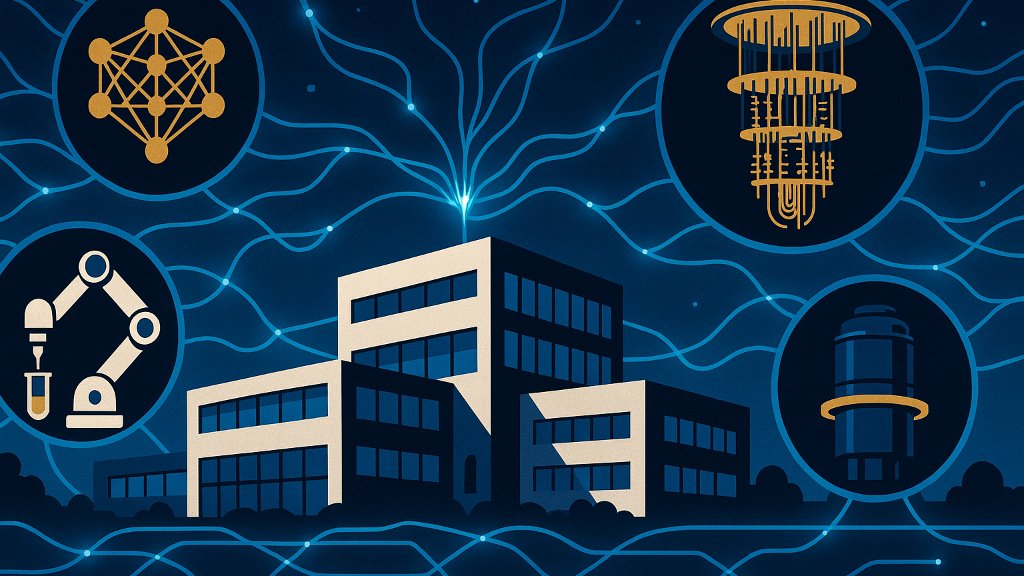
The National Science Foundation and Department of Energy announced more than $100 million for super-intelligence-enabled scientific instruments and autonomous laboratories. The White House said the effort follows NSF’s July announcement of a $400 million investment in programmable cloud laboratories intended to expand access to automated scientific research.
The broader package includes a $1.8 billion virtual biology initiative involving the National Institutes of Health, the Energy Department and Biohub. It also includes a $215 million Quantum Genesis competition and a NASA-DOE partnership focused on space nuclear systems, including a nuclear-powered spacecraft to Mars that the White House says is expected to launch in 2028.
Why it matters for technology
The plan makes AI infrastructure a central part of national research policy rather than a tool used only by private software companies. Large-scale computing, shared datasets, specialized instruments and automated experiments could affect research in areas such as drug discovery, materials science, energy and climate modeling.
Its impact will depend on how agencies distribute funding, how research results are shared and whether universities and public laboratories receive practical access to the promised infrastructure. The administration’s use of the term “super intelligence” also reflects a policy decision to organize research programs around increasingly capable AI systems, although the announcements do not establish a new consumer AI product.
The National Science Foundation separately announced an Office of Metascience to study new methods for evaluating and funding research. NSF also announced two $33 million Grand Research Challenge competitions focused on quantum applications and synthetic multicellularity.
What happens next
Most of the announcements are funding, partnership and organizational commitments rather than products that consumers can use immediately. Agencies will need to publish program rules, identify eligible institutions and define how companies’ computing contributions will be delivered and measured.
For technology developers and researchers, the immediate change is a larger public-private effort to connect AI models, high-performance computing, scientific instruments and automated experimentation. If the programs deliver on their stated goals, those systems could become a significant part of the infrastructure used to conduct scientific research in the United States.
References
- The White House. (2026, October 8). Fact sheet: Trump administration announces the most ambitious set of science initiatives this century. https://www.whitehouse.gov/fact-sheets/2026/10/fact-sheet-trump-administration-announces-the-most-ambitious-set-of-science-initiatives-this-century/
- National Science Foundation. (2026, October 8). NSF lays the foundation for the next generation of technologies and support for American talent. https://www.nsf.gov/news/nsf-lays-foundation-next-generation-technologies-support
- U.S. Department of Energy. (2026, October 8). Energy Department announces new Genesis Mission awards to advance super intelligence for science. https://www.energy.gov/articles/energy-department-announces-new-genesis-mission-awards-advance-super-intelligence-science