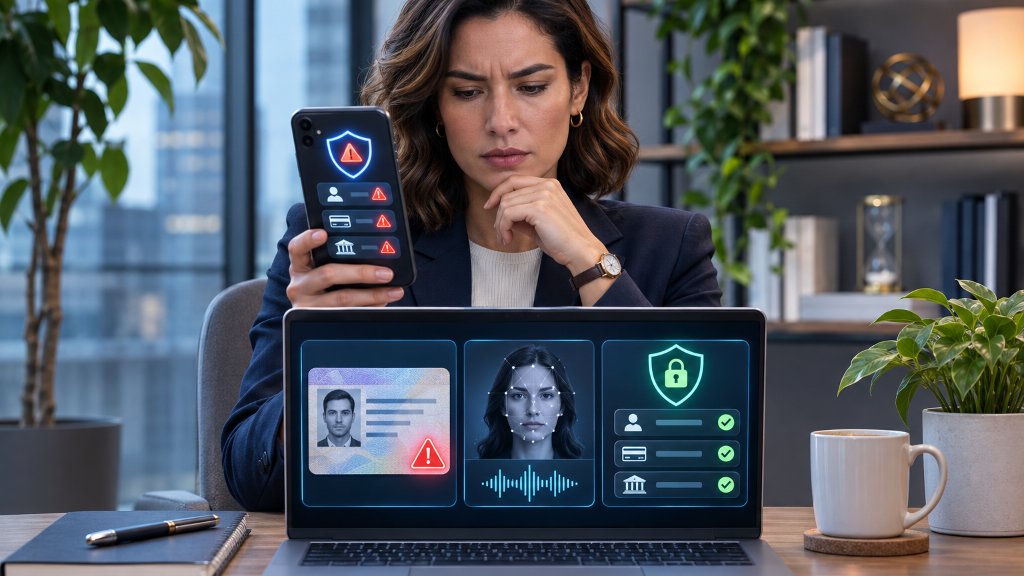
Artificial intelligence is making identity fraud more convincing. Criminals can create fake documents, voice clones, profiles, and videos. These materials can support account takeovers or new-account fraud. A few practical defenses can reduce your risk.
Understand synthetic identity fraud
A synthetic identity combines real and fake information. A criminal may use your name, address, or Social Security number. They may add a fake phone number or a computer-generated photo.
The U.S. Department of the Treasury says criminals use AI to create fake profiles, identity documents, voice clones, and videos. These tools can support phishing, loan fraud, payment fraud, and money laundering.
Treasury also says criminals have opened accounts using identities suspected of being created with generative AI. The 2026 National Money Laundering Risk Assessment describes these risks in detail.
A deepfake is synthetic media that imitates a real person. It can include an altered photograph, a fake video, or a cloned voice. Treasury says these materials can be difficult for consumers to detect.
Secure your most valuable accounts
Start with your email account. It can unlock banking, shopping, social media, and government accounts. Protect it before less important accounts.
- Use a unique password for every important account.
- Store passwords in a reputable password manager.
- Choose a passkey when a service offers one.
- Review account recovery email addresses and phone numbers.
- Remove recovery methods you no longer control.
A passkey is a device-based login credential. It uses cryptography instead of a password that you type. The credential is tied to the legitimate website or app. A fake website cannot normally collect it as a reusable password.
The Cyber Security Agency of Singapore describes passkeys as phishing-resistant authentication. Microsoft also describes passkeys as a strong defense against password theft and phishing. Its 2026 passwordless authentication guidance explains how passkeys differ from passwords and security keys.
Limit exposed personal information
AI fraud often begins with information gathered from public sources. Review social media profiles, public resumes, old listings, and exposed contact details.
- Hide your home address and personal phone number.
- Remove your birth date from public profiles.
- Limit photos of identity documents and travel records.
- Delete old accounts that you no longer use.
- Be careful when posting voice recordings or detailed family information.
Do not send an identity document because of an unexpected message. Do not trust a caller simply because the voice sounds familiar. Verify the request through a phone number or website that you already know.
Never share a one-time login code with a caller. The Federal Trade Commission advises people not to give personal information to unexpected callers, emails, or texts.
Monitor credit and account activity
Check your bank and card accounts for unfamiliar activity. Review your credit reports for accounts, inquiries, addresses, or employers you do not recognize.
You can get free weekly credit reports through AnnualCreditReport.com.
A credit freeze limits access to your credit report. It can make it harder for someone to open a new credit account in your name. The freeze is free. You must request it from Equifax, Experian, and TransUnion separately. IdentityTheft.gov explains the process.
A fraud alert is another option. It tells businesses to take extra steps before opening new credit in your name. A one-year alert is free. Contacting one credit bureau should notify the other two.
Consider a freeze if you rarely apply for new credit. Consider an alert if you suspect your information was exposed. These tools do not stop every form of identity fraud. They focus mainly on new credit accounts.
Respond to warning signs
Act quickly if a company contacts you about an account you did not open. Contact the company through its official website. Do not use a phone number from a suspicious message.
- Ask the company to close or restrict the fraudulent account.
- Change passwords for related accounts.
- Contact your bank if money or payment details are involved.
- Place a fraud alert or credit freeze.
- Report the identity theft at IdentityTheft.gov.
The Federal Trade Commission says IdentityTheft.gov can create an identity theft report and recovery plan. The site also explains how to dispute fraudulent accounts and request a credit freeze.
Keep copies of reports, messages, account notices, and confirmation numbers.
AI tools can make identity fraud more convincing. Your best defense is not spotting every fake image or voice. It is reducing exposed information and protecting account recovery paths.
Require independent verification before sensitive actions.
References
AnnualCreditReport.com. (n.d.). AnnualCreditReport.com. https://www.annualcreditreport.com/
Cyber Security Agency of Singapore. (2026, August 26). Understanding passwordless authentication. https://www.csa.gov.sg/alerts-and-advisories/advisories/ad-2026-011/
Federal Trade Commission. (2024, September). What to know about identity theft. https://consumer.ftc.gov/articles/what-know-about-identity-theft
IdentityTheft.gov. (n.d.). Credit freeze. https://www.identitytheft.gov/credit-freeze
IdentityTheft.gov. (n.d.). Recovery steps. https://www.identitytheft.gov/Steps
Microsoft. (2026). Microsoft Digital Defense Report 2026. https://www.microsoft.com/en-us/corporate-responsibility/topics/cybersecurity/reports/microsoft-digital-defense-report/
U.S. Department of the Treasury. (2026, March). 2026 National Money Laundering Risk Assessment. https://home.treasury.gov/system/files/246/2026-NMLRA.pdf